There are many ways into a horse's mind and heart, these are some of my ideas ...

Monday, March 7, 2011

Nice sort of update...


The two girls have actually gained a bit of weight each - Bell about 30kg and Steph about 10. They will be going into winter with good smooth covering. By official winter, I hope to get about 10 more onto Bell and hopefully 5-6 onto Steph. It isn't that Steph doesn't get as much as Bell or anything, it is just that her body is so thrifty it only uses what it needs and passes out the rest.

I let them grow their winter coats well before I start rugging them regularly, so they have a bit more warmth. Usually it is not too cold, even at night, till late May/June. If the temperatures drop I will put them on if they need them - I have even been know to go out at midnight because the temperatures dropped more than I estimated.

I will have to get Steph a new rug this year. Last two years I had sewn an acrylic blanket into a hessian light rug, but after the weather last summer, I am expecting it to be much colder this year. We hardly had any hot weather this past summer.

In winter when they have their meals, I add warm water to it. I think it is especially important for older mares. So much of them has gone into their babies, that sometimes the warming isn't as good as it should be. They seem to love the warm food, anyhow, and it is no extra bother.

During the time I will be off with my operation and recovery my grandsons will continue to care for the mares, with supervision by my partner in Bell.

We could have done with a bit more rain here for getting the last strands of grass going into winter, but it doesn't seem to be going to happen.

Wednesday, December 29, 2010

Stephanique Information

The imported purebred Arabian mare SH Stephanique is alive and well and living with me. She will be 28 in March 2011. As such, as being "old" she is well cared for and will never be attempted to breed from again.

She has access to water 24/7 which is cleaned and refreshed every day - about 60 litres and there will be more available in the next few weeks when we get one or both of the baths fixed.

She has two meals per day, morning and night. This food consists of dairy meal, lucerne chaff and either Economix or equestrian pellets. She gets bran sometimes with her food and safflower oil (about 1/4 cup) to help soothe her stomach. She will eat almost anything and I believe that this is what is causing her to occassionally have "stomach aches". If she lies down and/or is showing early signs of colic my vet is contacted. He is available 24/7 and is a horse specialist. He keeps current with everything as he is the District Vet for the AJC so TB's can be registered.

She is on a worming and farrier routine that is normal for any horse.

She has freedom to walk the entire property (6.5 acres) as we keep the gate closed. We have three stables, a large shelter and an overhang from a shed for shelter which she can and does choose as she wants. We have many large and shady trees on the property. She has a fly veil and is sprayed for flies every few days during the warmer months - as the weather requires.

She is treated like a pet with the TB mare I have here. She gets carrots and/or apples every single day. There is almost always someone here on the property all day every day. I personally check on her several times a day including a thorough inspection of her body and under her hooves. Nicks and scratches that draw blood are treated with antiseptic and anything that would require stitches would mean a call to the vet. So far (touch wood) she has not cut herself that badly.

Any enquiries regarding her and her treatment you can PM me through my profile.

Sunday, February 7, 2010

Long time between bets ...

Not much is happening with the two girls. They have settled into their usual routine, which mostly consists of sporadic grazing, loafing and dozing, and a mad dash at dinner time. Bell can be very bossy at feeding time, as she is Boss Cocky, but they have settled down into it. They have taken to mutual grooming, which has been a while getting to, but I take it as a good sign.

The funniest thing is when they loose each other and go tearing around in opposite directions trying to find each other. Neighing and nickering. Often we have to go out, and hold one and call the other. Usually it is Steph who wanders off and Bell doing the searching.

We might be getting another mare soon, and I shall try to blog more often. I still think of breeding Bell, but I will just have to wait and see what happens this year.

Wednesday, August 26, 2009

A new horse ....


SH Stephanique joined the creatures and animals of Unicorn farm back in July. She came down from Allyndah Arabians at Tyndale. She is a lovely chestnut purebred Arabian Mare. She is about 26 years old, no longer breeding but a beautiful, gracious animal to have around. She is in optimal health for a horse, and especially one of her age. She is mostly a companion for Her Ladyship the ex-racehorse, but she is an entity in her own right.


Thursday, January 1, 2009

A Passing ....

Secret Savings (imp USA) 1991 - 2009

The sire of our first foal, who we called Goldie, had to be put down.  His name was Secret Savings and he won the Doncaster back in 1997 and smashed a couple of course records in his racing days in Australia.  It wasn't much of a surprise that Goldie smashed her maiden in class record time, but it was nice that she did so.  

I do not know any of the details, but apparently he had laminitis a very painful condition in the horse's hooves.  He would have been 17 years old and a painless end is what he would have deserved.  He was owned by HH Nassar Lothar, from the Middle East at Emirates Park.  

We are sad he is gone, he sired some terrific horses, including our Goldie (racing name Zelotti).


Friday, October 17, 2008

...Sooky ...

Her ladyship, the ex race horses, aka, Bell, is a softie at heart.

Last Saturday, she had a hair or dust in one eye. I washed it with water, and opened it up to have a look incase there was something embedded in the ball. There wasn't. She rubbed it on me a fair bit and on her knee. At one stage she lay down and tried rubbing it on the grass. I let it weep, knowing it would eventually wash away, but if I thought she was in pain or it was worse, I would have called the Vet.

She stood around with me all day, just complaining about her eye and wanting cuddles and soft talking to. A couple of times I fiddled with her mane, because she likes it. After a couple of hours, the eye had flushed whatever had been in it and she was okay. But she still stayed close to me until her dinner time.

Most days now, when I am home, I give her rubs with the rubber curry to get rid of her fur. She is in full shed now and itchy as anything. A good rub seems to help this.

Saturday, August 16, 2008

Pelage ....

Moulting, shedding, major itching ....

Her Ladyship the ex-racehorse is in full shed. Hair is literally falling off her. We use a brush and curry comb on her almost everyday to help get rid of it. But almost any tree, branch, thing sticking out, including barbed wire is fair game for a shedding horse.

Itching is the worst thing about shedding, and you really need to be careful what your horses use to scratch themselves with. On warmer days a warm bath followed by a vigorous towelling down can help. Her Ladyship also uses an old woodchip pile to roll in. Literally dives into it. You can see her scratching her back. She so loves it.

Some people will clip at this time of the year, but the shedding is still going to happen, and there isn't much you can do about it. Just watch where it is being done. Keep an antiseptic spray nearby and check the old bod out for cuts and scratches.

Sunday, June 15, 2008

A dress for Her Ladyship ...


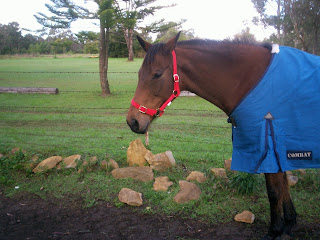
Our mare finally got her new rug yesterday. We drove out to Narellan to the Horselands there. They were having a sale so we got it fairly cheaply. She also got a new halter. She wears a halter 24/7 as she escaped once and my partner, not being a horse person, had to go and fetch her home again. She was very spooky being away from home, so the halter being on her at the time made her easier for him to catch. She has learned to live with it and doesn't get caught up.
We teach our horses distinct words for things, and in the case of the rug it is "jamas". This came about when ES was young and getting his first rug. We wanted him to know it was something positive, so we allowed him to smell it. We folded it up and placed it over his withers, unrolling it a bit at a time. While he was eating, so that he was partly distracted. Luckily it was something he wasn't bothered about because he had seen us put one on his mother. As she did not fuss about it, he did not fuss either.

His older sister, Goldie (AJC Zelotti), grew very thick hair and totally refused to wear a rug. She was never cold. ES never had anywhere near as much hair and really needed one. The mare does not have much of a winter coat and as it is getting very, very cold she really needed one. There will be frost before the end of winter. The rug is wool felt lined and very warm.


Blue Bell Babe in her blue rug and new red halter.

Friday, April 18, 2008

Training issues ...

Training issue come mainly from one source - people. Therefore as the person who has to solve the issue you have to sort of reverse engineer the problem. Get to a stage just before the horse shows signs of the issue and look at what the next step is that causes the issue and stop there. I am not saying to let the horse get away with whatever it is doing, just observe the steps taken to reach that point.

The next step you should take is to do something else completely different. If your horse is anticipating the issue to arise, but you do something else, the interest is taken away in whatever it is used to doing (i.e. the "issue") and now doing something completely different. Do this a few times and then go back to the issue.

If, for example, your horse takes a step away from you when mounting, make all the movements up until the point of mounting, and then perhaps lead him on and around in a big circle. This will break his anticipation of mounting/stepping away and distract him. You would need to do this a few times, to "throw him off". Then come back to the mounting. If he has begun to anticipate you leading him on, instead of mounting, he should stand. Pat him, and tell him how good he is. If, however, he still steps away, another, reverse action can be taken, for example, mounting from his opposite side.

Horses are two sided animals. You cannot do one thing to one side without doing it to the other. However, very few people think to mount from the other side. They just are so not used to doing it themselves, that it is almost as though you have landed from Mars. But - and I cannot emphasise this enough - you must teach your horse from both sides. So obviously you need to learn from both sides as well. If this is awkward for you, practice on a barrel or something for a while till it is easier. You probably have to retrain your muscles.

We only mount from the near side because it is "traditional"; soldiers kept their swords on their right, so the mounted from the left (near). But we are not soldiers and do not have swords (at least I hope you don't). So there is no real reason why you cannot mount from the other side.

This sort of reverse engineering an issue will keep things calm and not spooky and you and your horse can work fine together. Just put a little imagination into it. You will also find that your horse appreciates a break from "routine" and will probably repond more brightly as well.

Sunday, March 9, 2008

Living alone ...

So my mare is still alone. She spends her nights locked into her main paddock, unless a storm is brewing when she will now go into her stable. I guess part of the reason we don't force her to stay there is that the stable used to be used as a training holding gate for endurance horses, and has a concrete floor. Too long standing on concrete, they say, is not good for horses' legs. Oh?

Well, try telling that to Her Ladyship. After her 6.00 am feed of a morning she paces up and down the fence, wanting out. These days with having had so much rain the grass is quite long and the tips are sweet. Does she want out to graze? No, she wants out so that she can stand at the back door waiting for a carrot, a treat, talking to or a brush. She stands with her head in the door so she has full view of the kitchen and can watch the comings and going. One back leg cocked, gently swishing flies with her tail. Even if we are mean and shoo her away, she will go off, sulking and watch from an area nearby. This is in the sun, but she can see pretty well the entire property from that vantage point. Eat grass, you stupid horse. Nope.

The fencing here is very poor quality and has deteriorated since we have been here. We were promised it would be done when we first moved in, but while they keep promising, it has never been done. We thought at one stage of doing it ourselves, however, since we have decided to move on at the end of the year, it really isn't worth doing. So I doubt if we will get another horse just now.

She is going off at the end of July to get ready to be bred. Once she is safely in foal she will be sent to someone's place in Queensland to await us. Otherwise it is too much fussing around during pregnancy. She is basically a happy horse, but she is always a little spooky if her routine changes too much. I don't want to get her pregnant and for her to reabsorb or abort the foal because she is too stressed.

When she went away in 2001 to get pregnant with Eternal Strangers, they chose the hottest day of the year to send her home. The driver drove to Gosford and unloaded all the horses and gave them water and food for the night, and continued the trip the following day. He didn't charge extra for this and we were very grateful he did this. He explained that with Bell on the truck, because she travels so well, he puts her on first and the others follow with much less fuss. She seems to have a quietening effect during travel as well, and the company loves taking her. I guess I should hire her out in between breedings - lol.

EI was a nightmare, because we should have had her bred for a foal this year. Now when I consider the fencing problem, I guess in some respects, for us at least, since she never got the infection, it was a bit of a blessing. The microchip is forgotten and we just live day to day.

Thursday, December 27, 2007

I wish I could show her ...


This absolutely beautiful young man is to be Her Ladyship's next breeding partner. He is straight Egyptian Arabian. His name is Chaswyck Caliph. She was to see him this year but was delayed by the outbreak of Equine Influenza.
This young stallion is heavily bred to Asfour (Malik x Hanan) who was imported from Germany for Simeon Stud. Simeon Stud has bred some of the most beautiful horses in the World, including a World Champion Stallion. They mostly breed Egyptian Arabians.
But Chaswyck Caliph was bred at Chaswick Stud, another Egyptian breeder, by their stallion, Simeon Sochain. He is a beautiful Chestnut stallion, loved and admired all over the world.
I feel if she knew she was going to visit him next year she might cheer up a bit. Alas, our communications are not that good.
The foal could actually be chestnut, since Her Ladyship's dam was chestnut. I am not too fussed over the colour, I would be just as happy with a grey or bay, but I really think the foal will be something to behold in conformation with this breeding. The mare has very good legs and shoulder, as has this young man. He has a very powerful hindquarter, which I am delighted with, and I am sincerely hoping it will be passed on to the foal.
A colt will be gelded at two months. That is the law around here. Meanwhile there are lots of things to do: keeping her in good condition, getting her next EI vaccine, having the vet check she is actually ovulating and so on.
She has been rubbing her neck where the microchip was placed. We have been trying to prevent her from doing this, but she does it whenever we can. I guess all the theory in the world wont prevent her from dislodging it or damaging it if she is really determined to do it. She doesn't know what it is and if it is annoying her, why not rub the damn thing?
So enjoy the picture.

Thursday, December 20, 2007

Her Ladyship, the ex-Racehorse ...

She's a sweet old thing, our mare. She is so lonely at the moment she has taken to following the old person around while he does his outside chores. He says it is like having a big, spooky dog.

When we came home from Christmas shopping last Saturday, the boys ran ahead of us with the trolley and parcels, and were calling her. She came galloping up to see what was wrong. She so cares about those boys.

Her hair is so fine, her face is drier than any Arabian horse's head. Her legs have dried out and are just slightly feathered at the back of the fetlock. Her hair is so fine on her body it is smooth and silky. She has blood vessels close to the surface to keep her body cooler - so if she passes that on to her Anglo-Arabian foal, endurance will definitely be on the cards. Right now she is an extremely beautiful animal.

We feed her good food, that we have experimented with over time. She is wormed on a regular basis, she is not supplimented at the moment, because she is getting loads of good grass as we have had some good rain. She is a little spoilt at the moment only because we are not sure of our status with EI and don't want to risk getting another horse here until it is all gone again. We have seen people out riding around here - we don't know if they are supposed to be or not. They don't talk to us: they don't know us.

One day it will be over and we will be able to get her a companion. Till then she only has us.

Friday, December 14, 2007

Something to amuse you ...

(From a thread on Straightegyptians.com)

Diane asked the following:

A list of titles added to a library...

The baby human
The anti-bias approach in early childhood
Family in transition
Curriculum controversies
The art of teaching primary science 12 to 18
Anger management
Assertiveness
Essentials of strategic project management
Children, families & communities
Computers, thinking and learning
Designing a thinking curriculum
Coat of many pockets
Formative assessment in the secondary classroom
Schooling for the knowledge era
Totally wicked!
Miss Lily's fabulous pink feather boa
Teaching mathematics to all children
How to talk to children about art
The psychology of B.F. Skinner
Just Stop and Think!
Not you again!
What else can I do with you?
Seven steps to ICT integration
The millennial adolescent
Learners with mild disabilities
The Differentiated Classroom
Right book right time
Teaching boys
The psychology of B.F. Skinner
Sociology of family life
Biomechanics and Exercise Physiology: quantitative modeling
Seeing red
Managing conflict with confidence
Storytelling in the classroom
Race, culture and schooling
Extraordinary performance from ordinary people
Learning to slow down and pay attention

Anyone like to suggest an alternative title to these with the Arabian Horse as the theme?
egThe baby horse
The anti-bias approach in Arabian Horse BreedingBreeding in transition
The art of teaching analytical Arabian Horse conformation
Foals, families & communities
Miss Lily's fabulous pink feather boa
A few could always remain - Anger managementAssertiveness etc

To which I replied:

The baby human - Imprint training
The anti-bias approach in early foalhood
The herd in transition
Curriculum controversies in Judging
The art of teaching mammalian science 12 to 18
Anger management (for humans)
Assertiveness (for Arabian horses)
Essentials of strategic project management of Breeding Programmes
Children, families, strains & communities of Arabian Horses
Computers, thinking and learning to outsmart your Egyptian Arabian
Designing a thinking curriculum for Egyptian Arabians
Coat of many pockets filled with carrots
Formative assessment in the secondary classroom at Pony Club
Dressage Schooling for the knowledge era
Totally wicked! Carrots recipes
Miss Lily's fabulous pink feather boa for reining horses
Teaching mathematics to all children, families, strains and communities of Arabian horses
How to talk to children about artistically braiding tails and manes
The psychology of B.F. Skinner for thinking riders
Just Stop and Think - does your horse really need that carrot?
Not you again! See these teeth?
What else can I do with you besides lawn ornamentation
Seven steps to ICT integration for Egyptian Arabians
The millennial adolescent two year old colt
Learners with mild disabilities - both human and other animals
The Differentiated Classroom - both human and other animals
Right book right time - duck.
Teaching boys not to play chicken with the stallions
Sociology of horse herd life
Biomechanics and Exercise Physiology: quantitative modeling after the rider has fallen off - again
Seeing red - before your horse shies.
Managing conflict with confidence - for Arabian horse owners
Storytelling in the classroom - how to learn truth from fiction
Race, culture and schooling in the dressage ring
Extraordinary performance from ordinary people - New horse ownership
Learning to slow down and pay attention before you get bitten.

I thought this might add a chuckle to your life.

Friday, November 30, 2007

Picking a pedigree ....

A horse's pedigree is a chart of ancestors of the horse, presented in a reverse round robin chart.
The male side is usually on the top and the female is on the bottom. The father is the sire and the mother is the dam (or in some cases, distaff). There are the father's parents and the mother's parents and then their parents and so on back as far as the chart displays.

The reason for the chart is to check what family or strain or breeding the horse comes from. It can be quite useful to know this, particularly for a breeding or racing horse. It can be useful when purchasing animals as it lets you know the quality of the animal you a buying. It can be useful knowing the potentiality of a foal and even for picking which stallion to breed to your mare.

When selecting a horse to breed with, whether the male or female, it is useful to look at the pedigree and to go and look at relatives of the breeding animal, say the grand parents, their other offspring, brothers and sisters to the parents and also their children. The more you can see, and preferably in person, the better idea you will get of the potential foal/s from the breeding/s. If not, get whatever photographs, videos and dvd's you can of these horses.

The pedigree should not be the be all and end all of the breeding selection, but it can help in determining what the final outcome will look like.

It is also useful to go to a breed society and learn more about the breed, whether it is the same breed as the horse you have in mind for breeding or another breed. The more you know the better informed you will be when you make a decision.

It is also useful to read books. The authors are usually long time breeders in the particular breed you are interested in and are considered experts by their peers. It is a huge subject that I have barely tickled on here.

Tuesday, November 27, 2007

Grooming

Sorry I have not blogged here for a while. I have been flat out with my course, work and other things life has a tendency to throw at me when I am not looking.

This is a more personal aspect to horses and their well being than normal, in that I am going to talk about her ladyship, the ex-racehorse.

She is quite arrogant and has found it a long time to learn to trust us. She will be going fine and then just take umbrage at something, and we are back to square one. Sometimes I get so annoyed to think about what must have happened to her as a racehorse.

She misses her son; of that I have no doubt. It has taken her till two weeks ago before she would venture down to the yard where he died. She had a good smell all around and settled to graze for a while and then went back up to her own paddock. We have not been able to get her a companion because of the Equine Influenza outbreak having put a stop to all horse movement. So she is very dependent on us for company.

I try to keep her groomed nicely, but mostly she wont stand still for it. Since she isn't going anywhere, I usually do not fuss about it. But on Sunday she was scratching great wads of hair off her back with a tree branch. I put her lead on, grabbed the rubber curry and began the circular rubbing that makes it so effective. I could not believe how much hair came off her. She has been shedding since early July, and with all the rolling and scratching she does, I felt most of it must have been gone.

After the rubber curry came the cat brush with metal bristles covered with plastic on the tips.
You would have thought she had died and gone to heaven with the long nose and twisted head she made. She thoroughly enjoyed it.

Then the soft bristle brush. She was sleek and shiny after that. To look at you would just think her summer coat is painted on it is so fine. And very soft. Her mane is unmatted and her taill is just touching the ground, suitable for keeping off flies for summer.

So if you see signs that your horse might be itchy with old shed, even if you think it is all gone, maybe a rubber curry will prove differently.

Thursday, October 18, 2007

Just a quick note ...

If I can I want to load a URL I think you should be aware of. The person who keeps this blog has a mission and a passion. I agree with much of what she writes.

http://fuglyhorseoftheday.blogspot.com

Please read her blog frequently and leave comments. It is a good learning resource.

Sunday, October 7, 2007

Foals

To me the most beautiful animal baby is a new born foal. They just seem so beautiful and embody all the things we love to see in horses, the long legs, the fluffy ears, the upright tail as they trot around with Mum, just cannot find anything to beat them in my opinion. I am not biased.


I like to think of a foal as the potential of all the good things in horses. They are at a good size and age to start training. While they are small they are still very impressionable.


When I read about foals, and talk to others about them, people often mention the idea of foal imprinting. I have the book by D Miller who is a vet and advocates getting the foal the minute it is born and touching it all over and then letting it get up to bond with its mother.


I think that as a system it would be okay if most people could train in it before they actually have a foal. I have heard plenty of stories of mares rejecting their foals because of the time the people took to do the "imprinting". Nature has a way with animals whereby the mother can quickly "forget" her foal if it has been taken by a predator, and the foal goes limp and soporific when taken by a predator. It is theorised that this helps lessen the shock for the baby. At that time of neo-natal delivery, nature does not discriminate within the systems of the animals that it is just a little human interference and not a predator taking the foal.


My preference is to let the mare and foal bond, and get to know each other for a few hours. In a small space. The mare wont be too interested in grazing much on the first couple of days anyhow. She should have an ample supply of water however, because she will be making quite a bit of milk for the foal. That isn't to say, either, that you shouldn't offer her any regular feeds you normally offer her. Nothing stands in the way of my mare and her dinner/breakfast.


It is a good time to catch the foal when it is about 12 hours old. Mum and bub have got a little used to each other, it is fairly steady on its legs and has had a little sleep. (If any one of these is missing or none of these things are present in your foal, please call your vet.) Get the foal's attention by going into the middle of the yard and squatting down. A curious foal will come to inspect. A protective mother may be a bit of a problem, but if you have worked with her a fair bit prior to the birth, and she trusts you, just put a lead on her, get the foal's attention.


When it comes up to you, allow it to smell you and investigate. Softly deter any nibbling that occurs, just softly push the little muzzle away with your fingers. Do everything softly and slowly. Once it is happy with you, stand slowly so as not to spook it. Take it around its chest and rump. Only for a moment. Make reassuring noises and only hold it for a moment. I would do this three or four times over a 24 hour period, till you can hold it up to a minute or two. Then as you hold it, pat it all over its body. In the next lesson, lift its feet up, one by one. Next you can put your finger gently into its mouth. Work gently and softly. If you give the foal a name, call the name as well.


But - make sure you also reward the mother with a reassuring pat telling her what a good girl she is etc. Then leave the foal untouched for about two or three days and then do it all over again. Restraining, patting, lifting up the feet. Then slip a halter on and off. Scratching helps too, especially around the tail area.


At about a week to ten days, the foal should be happy enough that you are not a predator and the mother reassured enough that you are not going to steal her baby. Add a lead to the foal halter and let it get used to it. Pull slightly, once it is used to it, to get it to step forward. Don't put any pressure on the foal to do this. No jerking whatever you do. The tiny poll isn't ready to have hard pressure applied. But the pressure on the poll is fundamental to all that the foal will do during its life with people, and the younger it learns to obey it, the better.


After two more days or about two weeks after birth, you will be ready to teach tying up.


My reasons for teaching such a young foal to tie up are that this too is the most fundamental thing a horse needs to learn to do. Tie up and stand still, for the vet, for the farrier for the dentist, for the trailer.


You will need a bicycle inner tube, an old one, tied to a sturdy post, and the lead. Put the halter on the foal as normal, and if you can, lead it to the post. Tie the lead to the inner tube and let go. The foal may pull a bit, but the inner tube is flexible enough to withstand being pulled. If the foal begins to really fight the lead, step in and hold the foal, speak reassuringly to it, and move it in your arms closer to the post. This is really important. You never want the foal to be afraid of being tied up but if you suddenly untie it because of panic, it has learnt that panic type behaviour will get it out of that situation. Being so small your natural reaction to its panic will be to free it. But the holding it and moving it forward so that it is not pulling against the post is better. Once it calms down, then untie it. Then fuss over it.

More than likely if the foal panics the mare will panic as well. Pat her and reassure her. The foal will more than likely run to mum for a nurse. She will smell it and calm down more. Leave off tying the foal now for a day or two, but make sure you don't leave it any longer. Once the foal stands quietly while tied, you don't need to revise this again till it is a weanling.

Although once my foals are eating food for themselves around 6-7 weeks, I give them their own food, because my mare is a stealer. A haynet and all as they grow. But at mealtime, when they are eating, part of the condition they get to eat is they are lead to their food and tied up for part of the time they are eating.

I "wean" about four months old. By this, I mean that I put the foal into the next stable and yard area to the mare, just make it so the foal can't nurse. However, prior to that, I will begin feeding the foal for a few meals in that area away from Mum, and build up to leaving it there for an hour or so after the feed. By this age, my mare isn't too worried as long as she can see her bub. The foals have been so curious about everything, they wander in and out of the stable, smell around the yard. I will put some toys in with them, a large ball, some brightly coloured traffic cones. This yard becomes their home from now on. After a month, the mare has dried up, and they can be let out together. During the month, the mare has two or three hours in her yard and the foal can get out and get grazing. As I said, as long as they can see each other, it isn't a big fuss.

Immediate separation of mare and foal which some people do, so they never see each other ever again, to my way of thinking is just downright mean. You don't need a foal out of your mare every year no matter how valuable you might think she is. It affects them mentally and it can lower the immune system in the weanling to the point it can die of catching something it would not even have if the immune system was not depressed. The life of a foal is not worth it either.

Returning them after a month, the foal may try to nurse. There is nothing there, it is just a comfort thing. Even if the mare cocks her leg to allow it to "nurse". My colt was still doing this as a three year old. It is rather like giving a full contented baby a dummy (pacifier). It is no big deal and don't make it one.

Now you have a happy weanling. It knows how to be tied up and stand still. It knows to lift its legs, how to lead and behave like a well mannered horse. Most weanlings are ready to strut their stuff to the world and are happy to be lead around. Now is a good time to start those other things with the bags and stuff. Now is a good time to teach it to come to its name.

Happy foaling.

Friday, September 21, 2007

Catch me if you can ....

So your horse likes to play hard to catch.

Then you have to ask yourself who is really the dumb animal.

If your horse is off on the back 40 then he is going to be fairly difficult to catch, but not impossible. You will need to work a little to overcome this problem, but if you follow my ideas you will overcome this and reduce the likelihood of it happening again.

First you will need to collect a few things, colourful and interesting things, like coloured buckets, a baby stroller and other interesting things. Take these down near the gate of his paddock. You will have to make a din to get his attention, but once he looks at you , ignore him and pay attention to the goodies you have with you. After a while your horse will come up to investigate. Give him a piece of carrot or apple, gather up your goodies and leave.

Don't do anything else, just go.

The next day bring all your goodies again, and do the same thing. Only this time let him have a smell of at least one or two things, pack up and go.

The day after that, again bring it all and start fiddling with it. When he comes up to you for his carrot/apple, get some patting in first and then a smell of the goodies. Give him his reward and leave.

Leave some gear behind the following day, taking maybe the stroller if you have one or a couple of buckets. You want some pats and even maybe put on the halter, let him have a smell and then the reward and leave.

The next day put on the halter, lead him around a bit, let him have a smell, then the reward and then another pat and go.

By this time he should be coming up by himself. He will tolerate doing things, as long as there is a reward. Now when he comes, pat him, do not use a halter or gear, just a pat and no reward.

Leave.

The next day, take the halter, lead, gear and a reward. When he comes up to you, go through the patting, halter, leading and smelling, then give him a reward.

Do this routine for about 10 days. It does seem a long time, but we are making a point. You want him to come, but on your terms. Rewarding him each time is him coming on his terms. You have to do this to start with, to get him to come to you.

After 10 days he is curious and coming because there is a strong possibility of reward, but he knows it isn't guaranteed.

When he comes up on day 11 or 12, put the lead on and walk him back to his stable. Handle him and do all the normal things, with occassionally giving a reward to keep his interest. Now he will come whenever you call him, because he may or may not be rewarded. The higher the probability he has of getting a reward, the more likely he will come every time. You need to make some choices here.

If on the other hand you can't catch him in a small space because he runs into a corner and offers to kick you if you get too close, you have a problem, but again it is not insoluble.

The main thing is to never let him get into the corner in the first place. Make things interesting enough that he wants to come to you. Get outside of the yard and get his attention with a yell or a whistle. Have something interesting in your hand, a coloured bucket, a doll or something. Let him come up to you and smell it. When you pique his curiousity he is more likely to be cooperative than boring, boring, boring. Maybe you need to rethink some of your routines as well. Get some toys going, for example a plastic bottle with some dry feed in it. Hang an apple from the ceiling of his stable. Use your imagination. If you make your horse's life more interesting he will be more responsive to you.

You might have to use a reward/not reward system as the horse above on the back forty. But don't you go chase him, let him come to you.

However, these situations come about because you have not shown enough dominance to your horse, which is discussed in the article below. You need to have a good think about your interactions with your horse.

Saturday, September 15, 2007

Who is the boss?

There are people who seem to think that horses can be treated as equals or as "friends". This is probably the basis of "Natural Horsemanship" and such like. This is also a formula for problems with your horse. Unless the horse has a clear view of the need to submit to humans, you are asking for problems.

In a herd situation, if a stallion senses danger and alerts his mares, he isn't going to tolerate a mare who is going to stop and argue the point with him. He is going to nip and kick her to submission. An alpha mare is not going to tolerate a junior horse interferring with her decision to move the herd to better grazing. It is not in the interest of the herd. She will kick that other horse or will cast it out to be fair game for predators rather than endanger the herd. So a horse needs a clear line of submission or its life will be in danger.

Like wise under domestication. The horse needs a clear line of submission or it will be in danger and it will put you in danger at the same time. Whether you like it or not, if you do not get full cooperative submission from your horse, it will take the initiative itself. Being an animal in a dangerous situation, it will take the only way it knows - run away! And what will be the result of that?

Using the word "submission" sounds very forceful and intolerant. But being wishywashy about it isn't going to help your horse. He needs a strong line of command or he is left with no choice but to take it himself. If you are weak, a horse will sense it. A good horse will try to protect you at the same time if it senses danger, and particularly if it is a male horse - even a gelding. However, it will have no respect for you and you will have a hard time convincing him it was a one off mistake on your part.

So while it seems a harsh thing to get your horse to submit to you, it really is a safety issue, both from the horse's point of view and your own.

I am not advocating beating the crap out of your horse and getting him to give in to your superior strength. I am advocating putting limits onto him. Learning to say "No" and being prepared to enforce it with a responding action, a slap, for example, or making him back up, anything to make him do what he is supposed to do. And then making him do it. This means teaching him to not be spooky of things and I have talked about bombproofing elsewhere. This means if you ask him to walk through a puddle of water, you let him learn that he wont drown in it and can cross it in one lesson. It means he learns not to attack you when you go to give him his dinner at night. And so on.

With foals, you teach them right from the beginning, that yes, Mum is there, but neither of you are going to die if you can't reach her for a moment because I am holding you. You tie them up at a few days old, so that if they need veterinary care they can be handled, and later farriered and dental work done. It is somewhat harsh to start off with, but with a good start, you have a respectful horse and a safe horse.

This morning, my mare came up to me for a carrot. She let me pat her and scratch her and brush her mane. Then I started stroking her ears. Her head just drooped and sagged. She was so enjoying her attention. But later on today, I thought she had cut herself, and I took hold of her halter and made her stand up so I could check her out. She did not fuss or pull away, she knew I meant business. I did not have to hit her or shout or pull her around. She is happy knowing I am in charge, and I am happy knowing she is doing what I want so I can inspect her quickly. Luckily she just had some mud and petals on her leg and nothing else. She is an ex-racehorse and she still has some issues, but as time goes by, she is becoming the horse she should be and she is quite happy about it.

Sunday, August 26, 2007

Artifical Insemination

I want to use this blog to educate you about what it is like to be under a National Lockdown as far as the movement of horses is concerned.

It is frightening.

I am concerned about my mare. I also feel so bad for breeders who have expectant mares or foals just born. The mares may not die if they get it, but the foals probably will. It will devestate breeding.

And the reason why? Because the Thoroughbred powers that be insist that TB stallions breed naturally and will not allow Artificial Insemination. So a stud had a shuttle stallion return from Japan where the influenza epidemic has ceased racing over there for about two weeks. It is a highly contagious disease that has not been in Australia before, so none of our horses have any sort of immunity to it.

Yes, the horses are only ill for about 10 days, during which time the poor horse feels really bad, then there is the recovery period afterwards. But after, getting over the weakness, building back up to whatever the horse is used for. It is just such an ordeal.

There is a cure for humans, and as a horse lover and lover of animals in general, it bothers me that there hasn't been any further research to develop it for animals.

Now it is here, it will probably always be here; being a threat every year to every horse. It is very frustrating, it is extremely annoying.

I'll have some more training tips very soon.